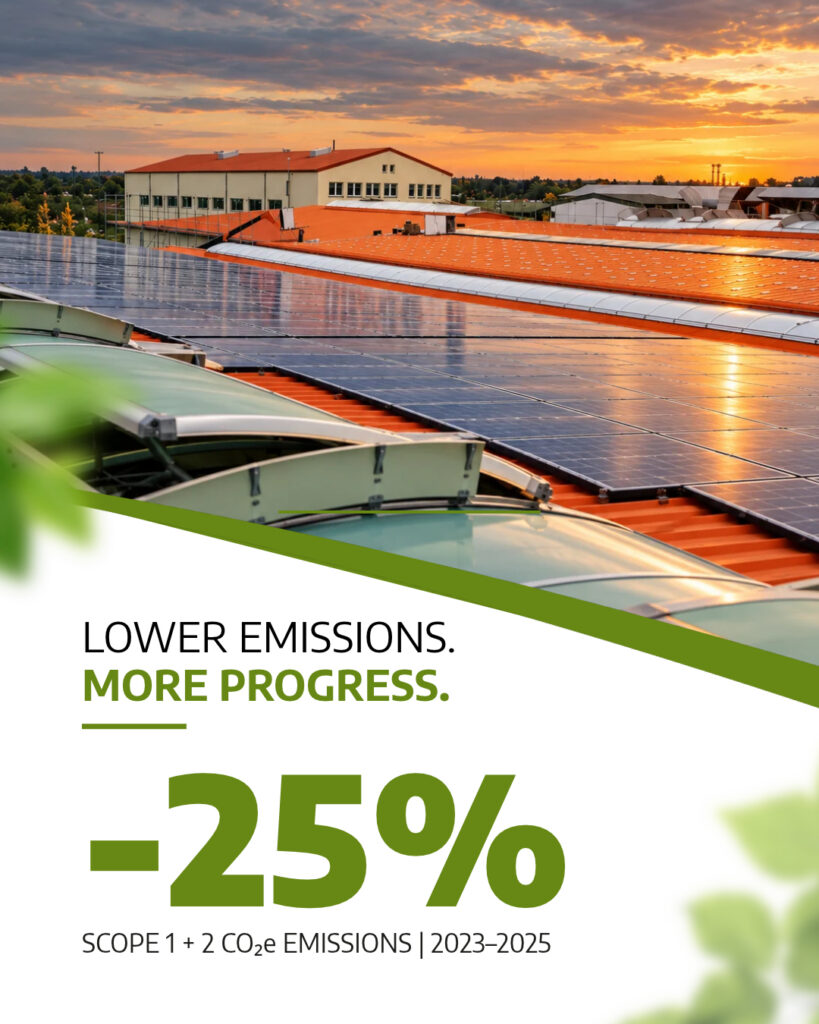
LIFTKET has completed its latest carbon assessment for the Wurzen site, documenting the development of greenhouse gas emissions over the past three years. The results demonstrate measurable progress while also providing a transparent basis for further improvements.
The assessment covers the years 2023 to 2025 and follows a Gate-to-Gate approach. It includes the relevant processes from the arrival of supplied goods at the site through to the departure of the finished products. The current assessment considers directly generated Scope 1 emissions as well as indirect Scope 2 emissions from purchased energy. Scope 3 emissions are not yet included.
Positive development since 2023
LIFTKET reduced its Scope 1 and Scope 2 emissions at the Wurzen site from 1,137.8 tonnes of CO₂e in 2023 to 851.9 tonnes of CO₂e in 2025. This corresponds to a reduction of 285.9 tonnes, or approximately 25%.
This development demonstrates the impact of the measures already implemented. These include the expansion of photovoltaic power generation, a growing share of renewable energy, improved energy management and initial steps towards a more efficient and increasingly electrified vehicle fleet.
When the renewable electricity generated by LIFTKET’s photovoltaic systems and fed into the public grid is also taken into account, the calculated carbon footprint decreased from 1,137.8 tonnes of CO₂e in 2023 to 566.1 tonnes of CO₂e in 2025. This represents an improvement of more than 50% within three years.
Forecasts for 2026 are already available and indicate that this positive trend will continue. At the same time, additional measures have been initiated to support a further reduction of our carbon footprint.
Transparency as a basis for further action
For LIFTKET, carbon accounting is not simply about reporting results. It helps us identify the most significant emission sources, evaluate the effectiveness of existing measures and define the areas where further reductions can be achieved.
Average carbon-footprint values have also been calculated for representative products from our different market segments. This information can support our customers in incorporating LIFTKET products into their own carbon assessments and sustainability reporting.
With a level of in-house value creation exceeding 90%, a significant proportion of our manufacturing activities takes place directly at the Wurzen site. This gives us a high degree of transparency within our production processes and enables us to influence many of the relevant factors directly.
Further improvements targeted through 2027
Our priority remains the avoidance and actual reduction of emissions. LIFTKET therefore does not intend to rely primarily on external offsetting schemes. Sustainable compensation measures for remaining emissions will only be considered once technically and economically viable reduction opportunities have been addressed.
To continue this positive development, further measures have already been initiated. Our key areas of action through 2027 include:
- increasing the use of electricity from renewable sources,
- improving the self-consumption of photovoltaic energy,
- further optimising heating systems and operating times,
- investing in more energy-efficient machinery and manufacturing processes,
- continuing the transition towards electric mobility,
- improving the planning of business-related journeys, and
- strengthening employee awareness of energy-efficient behaviour.
The latest assessment represents an important milestone, but not the end of the process. LIFTKET will continue to measure its emissions systematically, communicate its progress transparently and reduce its environmental footprint step by step.